 中文
 English
 Espa?ol
 Русский
Current position:Home > News & Events > News
Who Says PVC Lacks Strength SmallBoss Carbon Fiber Reinforced Rigid PVC Tops 158 MPa
At a Glance
In September 2026, Tongxiang Xiaolaoban Special Plastic Products Co., Ltd. (Small Boss) officially launched the world first carbon fiber reinforced rigid PVC extrusion profile. Reinforced with pure carbon fiber and containing zero glass fiber, the material reaches a verified bending strength of 158 MPa and a heat deflection temperature above 100 C, stays stable in strong acid, alkali and salt spray, and works as a replacement for aluminum, stainless steel and FRP. This article covers the verified data, the three breakthroughs, a full material comparison, applications, the customization workflow and an FAQ.
Who says PVC lacks strength. In September 2026, Small Boss officially launched its world first carbon fiber reinforced rigid PVC extrusion profile, putting the strength genes of carbon fiber into the body of PVC: bending strength tops 158 MPa, heat deflection temperature breaks 100 C, and the formulation contains no glass fiber at all. Metal rusts, FRP faces glass fiber compliance risk, and aluminum prices stay high. This new material answers all three problems at once.
01 Who Says PVC Lacks Strength That Is an Outdated Belief
Ordinary PVC has limited strength, that is a fact, but carbon fiber reinforced rigid PVC is a different material. People used to associate PVC with water pipes, window frames and sign boards. When engineers face chemical corrosion, outdoor loads or electrical insulation requirements, they rotate among aluminum, stainless steel and FRP and rarely put PVC on the shortlist.
Three old problems never had a good answer: metal profiles keep corroding in acid, alkali and salt spray, and maintenance cost climbs year after year; FRP resists corrosion but contains glass fiber, and EU dust control rules keep tightening, raising export compliance risk; aluminum and stainless steel stay expensive, and profile cross section design plus mold development keep a high barrier for ordinary projects.
Carbon fiber reinforced rigid PVC was developed exactly for these three unsolved problems.
02 What Is Carbon Fiber Reinforced Rigid PVC Extrusion Profile
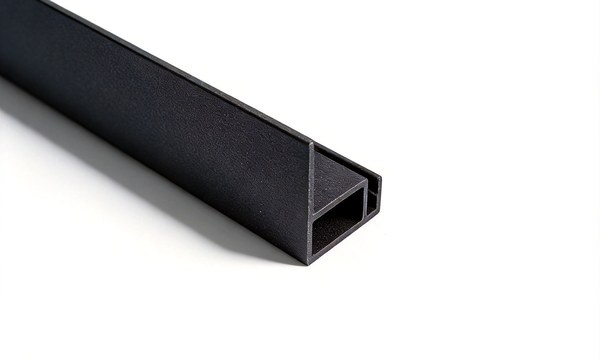
Carbon fiber reinforced rigid PVC is a composite profile that uses rigid polyvinyl chloride as the matrix and pure carbon fiber as the reinforcement, produced through continuous extrusion: it contains zero glass fiber, while delivering metal level bending strength together with the natural corrosion resistance and electrical insulation of PVC.
The formula grows out of the PVC compound system Small Boss has built over 30 years, and belongs to the high performance branch of the company PVC custom profile line. Compared with ordinary PVC profiles, its bending strength, bending modulus and heat resistance all step up; compared with traditional metal profiles, it naturally resists acid and alkali, is fully insulating, and never needs anti corrosion coating.
03 Three Breakthroughs That Give PVC a Carbon Fiber Skeleton
Stable mass production of carbon fiber reinforced rigid PVC rests on three real breakthroughs.
First, a pure carbon fiber reinforcement system. The formula contains 100 percent zero glass fiber, removing glass fiber dust risk at the source, so EU export carries none of the dust compliance burden of the FRP industry.
Second, continuous extrusion at industrial scale. Small Boss has achieved continuous extrusion of carbon fiber reinforced rigid PVC with complex cross sections in stable mass production. This is an industrial product that ships, not a lab sample.
Third, adjustable performance. Bending modulus, heat deflection temperature and impact toughness can all be tuned to project conditions instead of one formula for every job.
04 Verified Key Performance Data
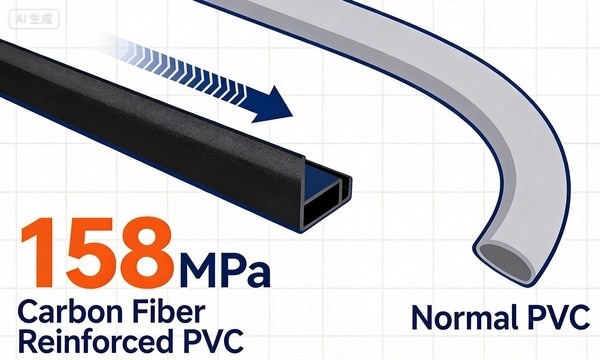
The verified data of the carbon fiber reinforced rigid PVC extrusion profile:
| Item | Value | Note |
| Bending Strength | ≥158 MPa | Near metal level strength |
| Bending Modulus | ≥10200 MPa (about 10.2 GPa) | Much higher rigidity, less deflection |
| Heat Deflection Temperature HDT | ≥100 C | No softening at 100 C service |
| Vicat Softening Point | ≥105 C | Solid heat margin |
| Density | about 1.39 g/cm3 | Roughly half of aluminum |
| Notched Impact Strength | ≥10 kJ/m2 | Impact resistant without cracking |
| Glass Fiber Content | 0 | Pure carbon fiber, zero glass fiber |
Note: all parameters can be customized to project requirements, and test reports are available on request. Metal level strength in a plastic material at half the density of aluminum, that is the most counterintuitive part of this material.
05 The Confidence to Replace Aluminum Stainless Steel and FRP
In corrosion protection and insulation scenarios, carbon fiber reinforced PVC profiles replace the three traditional materials head to head.
| Item | Aluminum 6063-T5 | Stainless Steel | FRP | Carbon Fiber Reinforced PVC |
| Glass fiber | None | None | Contains | Zero |
| Acid alkali resistance | Fair | Good but very expensive | Good | Excellent |
| Electrical insulation | Conductive | Conductive | Insulating | Fully insulating |
| HDT | Over 200 C | Over 200 C | 80 to 100 C | Over 100 C |
| Profile design support | Buyer side | Buyer side | Buyer side | Supplier assisted design and simulation |
| Performance adjustability | Fixed | Fixed | Limited | Wide custom range |
| Total cost | Medium high | Very high | Medium high | Competitive value |
Three sentences to remember: in corrosive environments it outlasts aluminum and costs less than stainless steel; for insulation requirements it is non conductive by nature, so solar frames and energy storage cabinets can skip extra insulating parts; in the EU market it contains zero glass fiber, so the compliance anxiety of FRP simply does not exist here.
06 Which Industries Can Use It Right Away
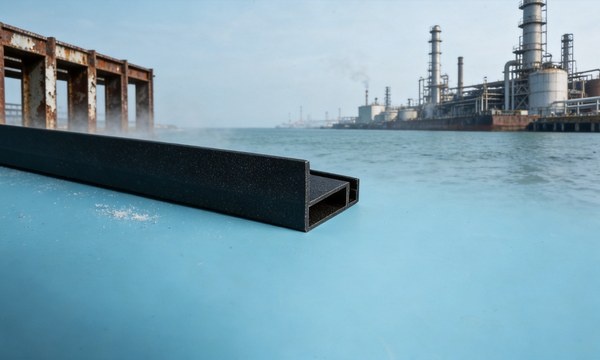
Wherever corrosion protection or electrical insulation matters, carbon fiber PVC profiles can be customized to the working conditions. Six directions come first:
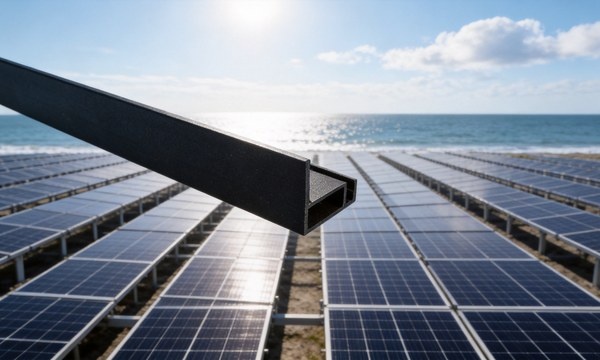
Renewable energy: solar PV frames are the launch specific solution for coastal, chemical park and tropical high temperature rooftop projects, with two options, an equal stiffness version matched to aluminum deflection and a cost effective version; insulation support profiles for energy storage cabinets are available in parallel.
Marine and chemical: seawater desalination brackets, chemical equipment frames and wastewater treatment profiles serve long term in strong corrosive media without rust or coating failure.
Electrical and rail transit: insulating profiles for high and low voltage cabinets and non conductive supports for rail transit solve leakage risk at the material level.
Industrial and agriculture: cooling tower internal supports, anti corrosion greenhouse frames and laboratory workbench frames.
Outdoor signage: sign frames for coastal and chemical zone environments, no rust, no fading, no cracking.
Tell us your working conditions, and carbon fiber PVC can be customized into the right performance and the right cross section.
07 Customization Workflow from Formula to Export
As a PVC compound manufacturer and PVC profile manufacturer, Small Boss runs the new product cooperation through six steps.
- Formula customization: modulus, heat resistance, impact and weatherability tuned to conditions;
- Profile design and simulation: engineers optimize the cross section and run mechanical simulation, buyers do not need an in house R and D team;
- Mold development and sampling: compatible with existing interfaces, fast proofing;
- Test report support: in house dual testing laboratories plus third party reports;
- Flexible MOQ: from small trial batches to full mass production;
- Global export service: customs and logistics support, products exported to more than 100 countries and regions.
08 FAQ
Q1: Does the carbon fiber reinforced PVC profile contain glass fiber?
A1: No. It uses pure carbon fiber reinforcement with zero glass fiber, so EU export carries no glass fiber dust compliance risk.
Q2: Can it really replace aluminum?
A2: It matches aluminum on bending strength (over 158 MPa), corrosion resistance and electrical insulation, with an equal stiffness solution for solar frames. For extreme conditions above 200 C or with very high loads, send us the working conditions for a case by case review.
Q3: Can performance be adjusted for my project?
A3: Yes. Bending modulus, heat deflection temperature and impact toughness are all customizable, with test reports available.
Q4: Our team has no profile design capability, can you design the cross section?
A4: Yes. Small Boss engineers provide cross section design, mechanical simulation and mold development. Buyers only need to describe the working conditions and interface requirements.
Q5: Is the material suitable for EU export?
A5: Yes. The zero glass fiber formula avoids dust control issues, the company exports to more than 100 countries and regions, and customs plus logistics support is complete.
Q6: How do I get samples and a quotation?
A6: Send us your working conditions and cross section requirements. Free samples are available, and quotation follows the cross section size and order quantity. Contact Marc Ding +86 15868365820.
Related Reading
- PVC Extrusion Profile Product Center
- About Small Boss
- Small Boss on Made-in-China
- Small Boss on Alibaba.com
About Small Boss
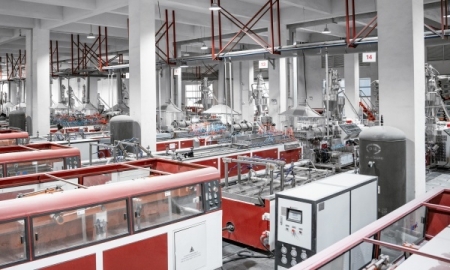
Founded in 1992 in Tongxiang, Zhejiang Province, Small Boss is a National High Tech Enterprise and a national level Specialized and Refined Little Giant company. The company operates a provincial level technology research institute, dual material testing laboratories and full ISO9001, ISO14001 and ISO45001 systems. With more than 30 years in PVC compound, MBBR bio filter media, plastic steel sheet pile and PVC custom profiles, Small Boss runs the complete chain from formula development, structural simulation and mold making to extrusion production and finished product testing, exporting to more than 100 countries and regions. Learn more
Free Samples Now Available
Send your working conditions and cross section requirements. Performance customized to your project, test reports included.
Contact: Marc Ding
Tel / WhatsApp: +86 15868365820
No.431 Tongsheng Road, Tongxiang Economic Development Zone, Zhejiang, China